Key Takeaways

Takeaways
- On October 30, 2025, Gauntlet USDT vaults absorbed $775M in supply assets, a 40x TVL increase, and fully recovered to pre-deposit APY levels within 10 days
- Recovery was driven by launching new collateral markets, optimizing vault allocations, and coordinating with ecosystem partners, with $627M in additional borrowing demand
- Active vault curation and Morpho's permissionless architecture enabled rapid response, proving institutional-scale deposits can be absorbed without long-term impairment of yields
- Institutions evaluating onchain vaults should prioritize curator operational capabilities and protocol architecture flexibility to ensure smooth integration
Introduction
On October 30, 2025, two Gauntlet-curated USDT vaults on Morpho absorbed $775M in a single transaction, one of the largest supply events in vault curation history.
Ten days later, APYs had fully recovered to prior levels.
With significant increases in both stablecoin market cap and DeFi vault TVL expected in 2026 as more fintechs and financial institutions seek onchain yield, this real-world stress test answers recurring questions we hear from companies exploring DeFi:
What happens to yield when onchain supply scales from $1M to $100M to $1B?
Can onchain vaults sustain APY at an institutional scale?
Let’s dive into the data.
Where does the yield come from?
Before we go into details and numbers on the USDT clip, let’s first consider where the yield distributed to Morpho vault suppliers comes from.
On Morpho, there are three primary actors: suppliers (lenders), borrowers, and vault curators.
On one side, lenders can supply assets to a vault; on the other, Morpho markets, where users can borrow vault assets by depositing collateral. Borrowers pay interest, which is then distributed to vault suppliers as yield.
Vault curators, such as Gauntlet, select which collateral borrowers can use to borrow from specific vaults, and set risk parameters that help keep the Morpho ecosystem healthy for both suppliers and borrowers.

For instance, as of February 2026, the Gauntlet USDC Prime Vault on Ethereum only accepts the bluechip assets cbBTC, WBTC and wstETH as collateral for borrowing USDC from this vault, creating a very conservative risk profile for the vault, as they have both large market capitalization and liquidity.
Then, each market gets allocated the USDC liquidity from the vault based on rigorous parameters defined by Gauntlet’s optimization engine.

Here is the current USDC Prime allocation as of publishing time:
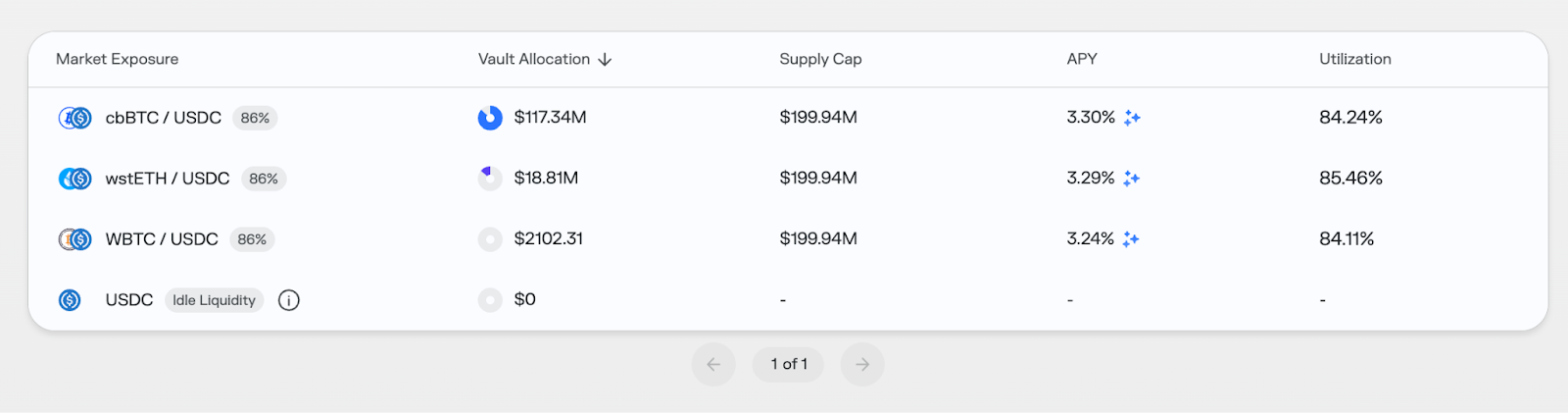
The allocation to underlying markets and their borrowing rates determines how much interest is paid from each market at any given time, which is then distributed as yield to vault suppliers.
Ensuring that borrow demand reaches equilibrium with supply is a key factor for APYs, and is supported by the Morpho interest rate curve based on a vault’s target utilization.
The target utilization is the ideal percentage of vault supply matched to active borrowing positions:
- If utilization is below target, interest rate for borrowing from the vault decreases, incentivizing borrows.
- If utilization is above target, interest rate paid by borrowers increases, incentivizing supply as vault APY increases accordingly.
There is therefore some natural elasticity of borrow demand from the interest rate curve, as borrowers are incentivized by lower interest rates when demand is low.
However, if there may be enough latent borrowing demand to match slight decreases in interest rates, what happens when supply dramatically increases?
The APY impact of a $775M supply event
On October 30, 2025, two Gauntlet-curated vaults on Ethereum received a $775M deployment in a single transaction:
- Gauntlet USDT Prime: $314 million supplied (22x increase from $13.8M)
- Gauntlet USDT Balanced: $470 million supplied(80x increase from $5.83M)
This is not only a significant inflow of supply and liquidity across Gauntlet vaults, but also at Morpho mainnet level for USDT, going from $163.8M to $915M, a 550% increase.
Here’s a snapshot of each vault before and after the supply increase:
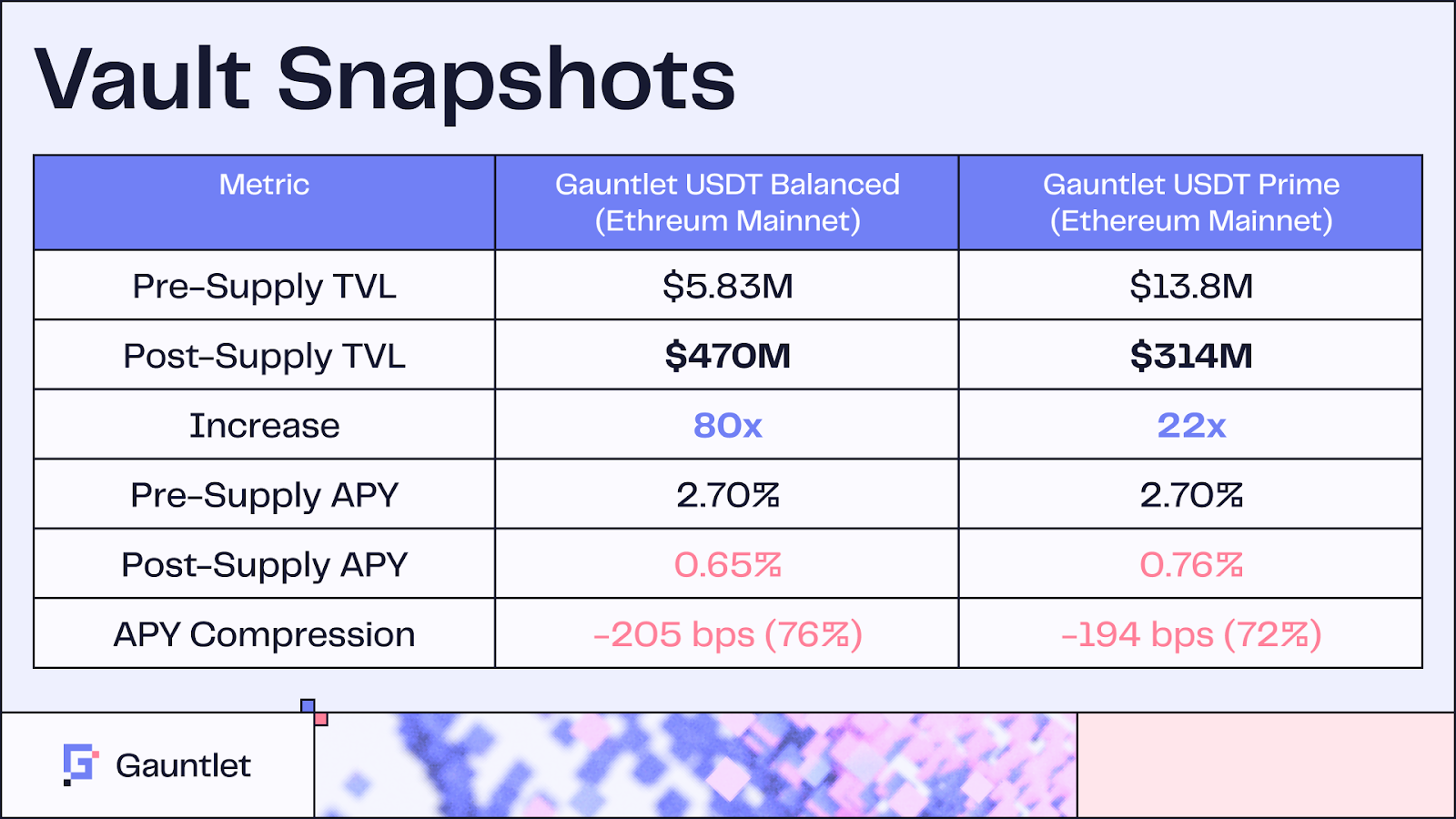
Table 1: Immediate impact of the increased supply to the vaults
As expected, APY decreased by over 70% immediately for both vaults as supply increased without an immediate corresponding increase in borrow positions, meaning the interest paid by borrowers was now distributed across a larger supplier capital base.
APY & borrow demand recovery
It took both vaults exactly 10 days to fully recover to their APY level before the large supply.
This was driven by three primary factors:
- The addition of new collateral markets to each of these vaults.
- The optimization of new and existing vault allocation to whitelisted markets.
- An increase in borrows from both the natural elasticity of demand and the coordinated efforts of Gauntlet and Morpho to generate demand from their partner networks.
Let’s look at these three factors and how they impacted vault APY.
New collateral market addition
New markets on Ethereum, cbBTC/USDT and thBILL/USDT, were launched by Gauntlet and subsequently whitelisted for both the USDT Prime and USDT Balance vaults. That means users on Morpho were able borrow USDT by depositing cbBTC or thBILL as collateral.
Additionally, the pre-existing sUSDS/USDT market was added to the allocation whitelist for both vaults. These new markets drove net new borrowing demand for USDT as they benefited from the increased supply and therefore lower borrowing rates.
Optimization of existing vault allocation
Gauntlet’s optimization engine continually evaluates market conditions and automatically rebalances allocation parameters (including the amount of vault supply allocated to each market) to capture yields from the highest-quality, sustainable borrow demand.
This optimization, combined with the new markets above and the efforts outlined below, led to $466M in borrow demand from just cbBTC and sUSDS. thBILL added an additional $5M in borrow demand while the rest was driven by increased demand for borrows from the existing WBTC and wstETH markets.
Borrow demand elasticity and coordinated efforts
The intrinsic elasticity of borrow demand on Morpho, driven by the interest rate curve, was a primary vector in returning to equilibrium with supply. In addition, Gauntlet and Morpho collaborated on targeted efforts to accelerate this rebalancing. Both teams maintain a diversified network of liquidity providers, spanning institutional participants, DeFi protocols, and large holders that may be interested in low interest rates.
The borrowed amount for the listed collateral markets increased more than eightfold between October 30 and November 9, reaching a total of $716M in 10 days from a benchmark of $89M.
Here is the breakdown of individual growth from these markets:
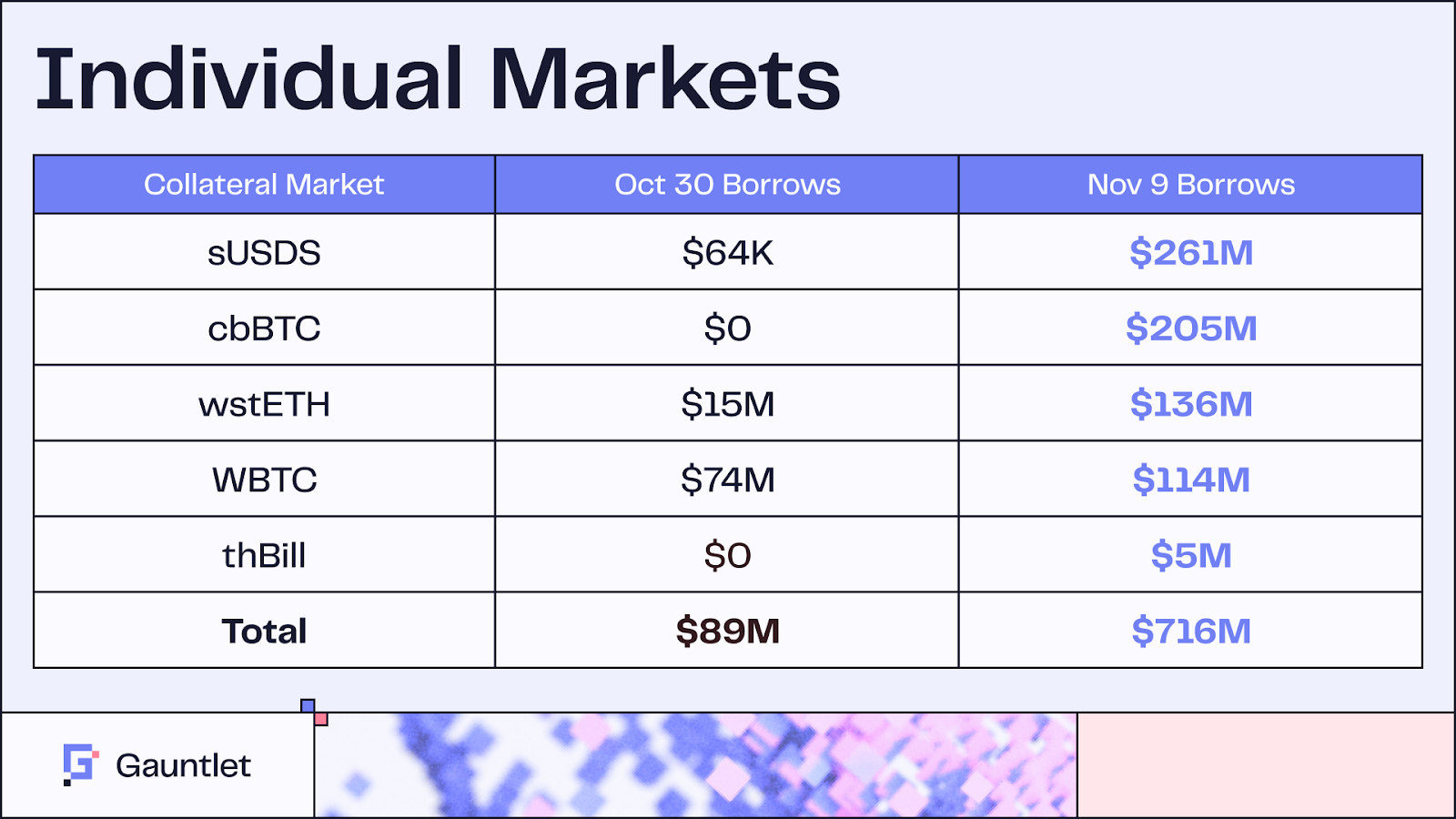
Table 2: Borrow demand growth by collateral market during recovery period
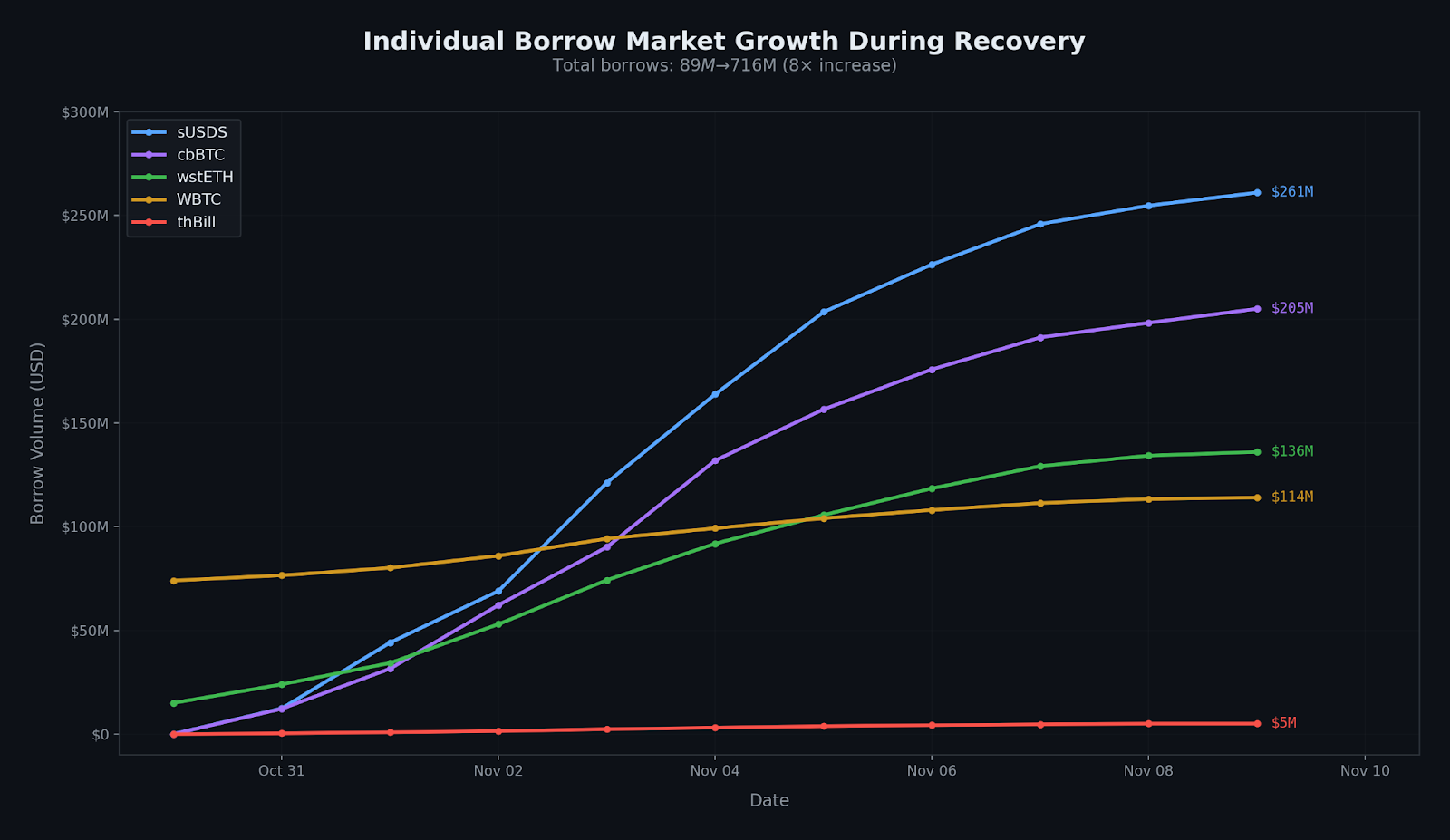
Graphic 1: Borrow demand growth by collateral market over time
Implications for the future of onchain vaults
Onchain vaults are ready for institutional capital
Gauntlet USDT vaults on Morpho’s Ethereum mainnet deployment absorbed a 40x supply increase and returned to supply/borrow equilibrium within 10 days.
While there was a short-term APY compression, which was expected from such a large increase in supply, borrow demand responded elastically as lower rates and the Gauntlet/Morpho partnership attracted additional borrowers from new and existing markets.
This directly showcases how Gauntlet-curated Morpho vaults can intermediate large, discrete inflows without structurally impairing long-term yield, which is what institutional capital allocators are looking for when exploring DeFi opportunities.
It also means that APY may remain sustainable for existing vault suppliers and institutional integrators as they grow and bring more supply to existing markets.
Partner & infrastructure selection is key
Morpho’s architecture and curator framework provide a control surface for rapidly listing markets and adjusting allocation weights through a labored governance cycle that can last weeks.
This architecture enables direct vault configuration via a permissionless listing process that can efficiently respond to dynamic market conditions or a significant onchain event, such as the supply we examined in this case study.
It enabled the Gauntlet curation team to be proactive in setting up new collateral markets, coordinating with ecosystem partners, and optimizing vault allocations to ensure an effective, fast recovery to APY levels before supply.
Institutions evaluating vault integrations should prioritize this level of architectural flexibility and proven curator networks, ensuring their capital can be absorbed at scale without compromising yield sustainability.
Active vault curation drives recovery speed
The 10-day recovery to pre-supply APY levels required deliberate, proactive curation.
Within 48 hours of the $775M supply, Gauntlet launched new collateral markets (cbBTC/USDT, thBILL/USDT), whitelisted sUSDS/USDT to create leverage opportunities, and recalibrated allocation parameters across the vault structure.
This active management approach stands in contrast to passive vault curation that relies solely on algorithmic rate curves. A purely reactive approach would likely have resulted in slower migration of borrowers into the new supply, lower utilization over a more extended period and more prolonged yield compression for suppliers
Gauntlet's ability to execute rapid responses stems from years of managing risk in DeFi since 2018, with a dedicated team of quantitative researchers continuously monitoring market conditions and optimizing parameters. For institutions evaluating vault integrations, the curator's operational capabilities, 24/7 risk monitoring, established liquidity provider networks, and proven experience navigating market stress are as critical as the initial vault construction.
Case Study
View the full presentation
Read the full paper