Key Takeaways

Part 1 of a three-part series on DeFi and tokenization for institutional participants, produced jointly by Ernst & Young and Gauntlet.
Introduction
Institutional activity in selected on-chain markets has increased, alongside growth in DeFi and tokenized-asset use cases. The same rails supporting $87.5b in value locked across decentralized finance (DeFi) protocols and $380b in tokenized assets as of Sept 1, 2026 are now used by a number of large companies. These companies are piloting or using blockchain-related capabilities for selected use cases that introduce potential for extended operating windows and different capital-efficiency features that are subject to product, network, legal, liquidity, and operational constraints.
Institutional experimentation and selected live deployments have increased. As of August 13, 2026, BlackRock has deployed over $2.7b through its USD Institutional Digital Liquidity Fund (BUIDL), J.P. Morgan launched a $100m tokenized money market fund, and Franklin Templeton's Onchain U.S. Government Money Fund (BENJI) has locked over $700m onchain. A tokenized Apollo fund is used in DeFi-native leverage strategies, and publicly traded digital asset treasury companies are tapping into DeFi through yield-generating vaults.
These deployments reinforce the potential of two interrelated onchain ecosystems to drive structural shifts in capital markets: tokenization and DeFi. Together, they enable greater capital efficiency for lending, trading, payments, and sophisticated yield strategies. Traditionally off-chain assets (e.g., Treasury bills, stocks, private credit funds) now serve as collateral in onchain lending protocols, provide liquidity in trading pools, and power automated yield generation strategies. Certain onchain transfers may reach technical finality more quickly than conventional workflows, although end-to-end settlement depends on the asset, network, cash leg, intermediaries, and applicable legal arrangements, and onchain processing may reduce selected reconciliation or processing steps, though total cost depends on implementation and operating conditions. The result is markets that operate continuously and composable financial products (protocols and assets that can be freely combined, like software libraries, so the output of one, such as a yield-bearing token, becomes the input of another, enabling new onchain use cases such as carry trades or levered looping) that operate with programmatic efficiency.
The relationship between onchain and traditional markets is mutually reinforcing, not zero-sum: onchain infrastructure gains institutional-grade assets and deeper liquidity, while traditional markets gain infrastructure that may support extended transfer windows and faster movement for eligible assets where the relevant legal, custody, liquidity, and operational arrangements permit.
Institutional use of blockchain infrastructure reflects a potential shift in how selected financial activities are recorded, administered, and executed. Smart contracts can automate certain functions, while legal agreements, custody arrangements, governance structures, service providers, and regulatory requirements continue to play important roles. Institutional onchain finance should not be understood as a single operating model. Some DeFi protocols support permissionless and self-custodial participation, while institutional implementations may use qualified custodians, controlled wallets, permissioned access, transfer restrictions, and other governance arrangements.
To understand why this is accelerating now and what it means for financial institutions, this report begins with the foundations: how DeFi reimagines financial services, what tokenization is, and the mechanics that make both possible. Part 2 will turn to the institutional opportunity itself, including current use cases, how institutions are accessing onchain markets in practice, and the risk considerations at the center of every allocation decision.
How DeFi reimagines financial services
The following section describes capabilities that developed primarily within crypto-native DeFi markets. These capabilities provide context for potential institutional applications, but institutional participation may use different custody, identity, governance, compliance, and access arrangements.
Decentralized finance developed as blockchain infrastructure and smart contracts made it possible to support programmable financial activities beyond basic peer-to-peer value transfer. Early and crypto-native DeFi models commonly allowed participants to interact through self-hosted wallets, although custody, access, and governance models vary and institutional implementations may incorporate custodians, controlled wallets, permissioned access, and other safeguards.
Harnessing the power of smart contracts, blockchain pioneers have built a decentralized financial system that reimagines many of the financial products and services that exist in traditional finance, and can create entirely new ones.
Replacing intermediaries and giving users control of their funds
Takeaway: DeFi replaces financial intermediaries with transparent, programmable smart contracts that execute transactions automatically.
DeFi protocols are built on public blockchains where immutable smart contracts perform functions traditionally handled by third parties, such as banks, brokers, and custodians. A critical feature that distinguishes DeFi from traditional finance is self-custody. Unlike traditional financial systems that rely on intermediary custody, DeFi enables users to maintain complete control of their assets in private wallets when accessing onchain financial services. Transactions between wallets and onchain protocols are publicly auditable via chain explorers such as Etherscan.
Some DeFi participation models allow users to retain direct control of assets through self-custody. This changes, rather than removes, the risk profile: participants assume greater responsibility for key management, transaction authorization, and operational security. Institutional participants may instead use qualified custodians, controlled wallets, multiparty authorization, or other custody arrangements intended to address governance, segregation of duties, and regulatory requirements.
Reported DeFi protocol exploit losses in 2025 totaled roughly $680.3m against an average TVL of approximately $121b, lower than the $2.62b calculated for 2022 using the same methodology. The figures cover exploits of DeFi protocols recorded by Immunefi over the calendar year, measured against average annual protocol TVL as reported by DeFiLlama, and exclude losses at centralized venues and individual wallets. Audit standards, formal verification, and protocol design have continued to develop over that period.
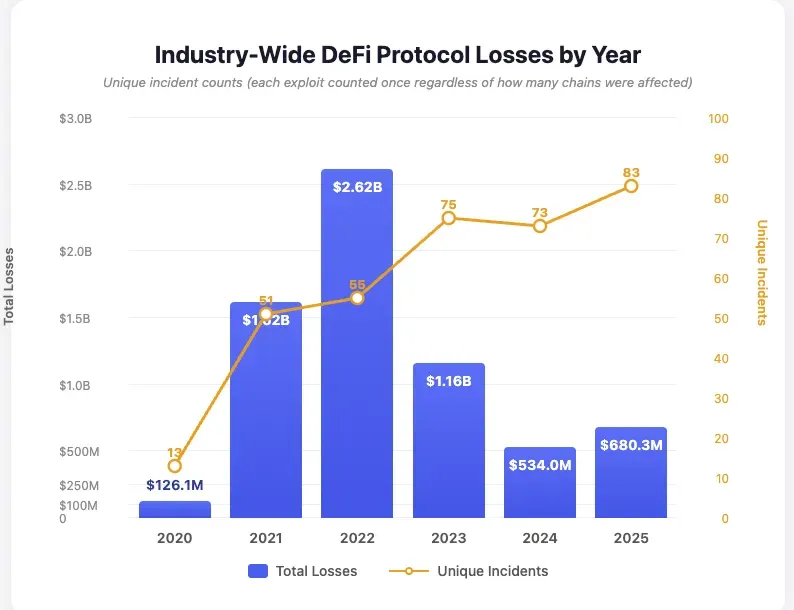
Figure 1: Industry-wide DeFi protocol losses and unique incidents by year, 2020 to 2025. Source: Immunefi, 2026 Ecosystem Vulnerability Audit.
Risk in DeFi is real and worth underwriting carefully. It is also measurable, and the frameworks for doing so are the central subject of Part 2 of this report.
Overall, the ecosystem, undergirded by the concepts of self-custody, transparency, and immutability, had approximately $87.5b in reported TVL as of Sept 1, 2026, according to DeFiLlama, and has drawn participation from some of the world's largest financial institutions. With that institutional participation continuing to build, it carries the potential to reshape how a broader set of users accesses and interacts with financial services.
A full stack of financial services onchain
Takeaway: DeFi has evolved into a system that supports onchain analogues of selected traditional financial activities including trading and lending, as well as digitally native structures.
DeFi has supported the emergence of an ecosystem of blockchain-based financial infrastructure spanning lending, trading (spot and derivatives), insurance, and other complex yield strategies.
Composability is the knock-on effect of two properties unique to DeFi: a non-custodial, permissionless base layer, and a stack of open token standards (e.g., ERC-20, ERC-4626) that give every asset a uniform interface.
DeFi's composability enables protocols to integrate without intermediaries or permission, creating scenarios where composed positions may generate multiple sources of return, while also increasing leverage, dependency, liquidation, liquidity, and contagion risks. A single asset can earn staking rewards and serve as collateral for a borrow position, which can then be supplied to a yield vault. This is fundamentally different from traditional finance, where assets must choose between being liquid or productive, and where moving capital between strategies requires multiple intermediaries and settlement cycles. Onchain, these functions can stack programmatically.
Composability cuts both ways: the same integrations that let capital stack across protocols also let stress travel between them, which is why exposure across composed positions sits at the core of the risk frameworks covered in Part 2.
Takeaway: Foundational mechanisms, trading, lending, staking, and vaults, form the infrastructure layer powering suite of financial services built on the blockchain.
Trading (spot and perpetuals): Decentralized exchanges (DEXs) enable peer-to-peer asset trading through two primary models. Automated Market Makers (AMMs) use liquidity pools in which prices are adjusted algorithmically based on supply ratios, often enabling near-instant execution without order books. Central Limit Order Books (CLOBs) match buyers and sellers directly. Perpetual futures, which function as futures products without expiration, provide leveraged exposure through funding rate mechanisms that keep contract prices anchored to spot markets and operate continuously.
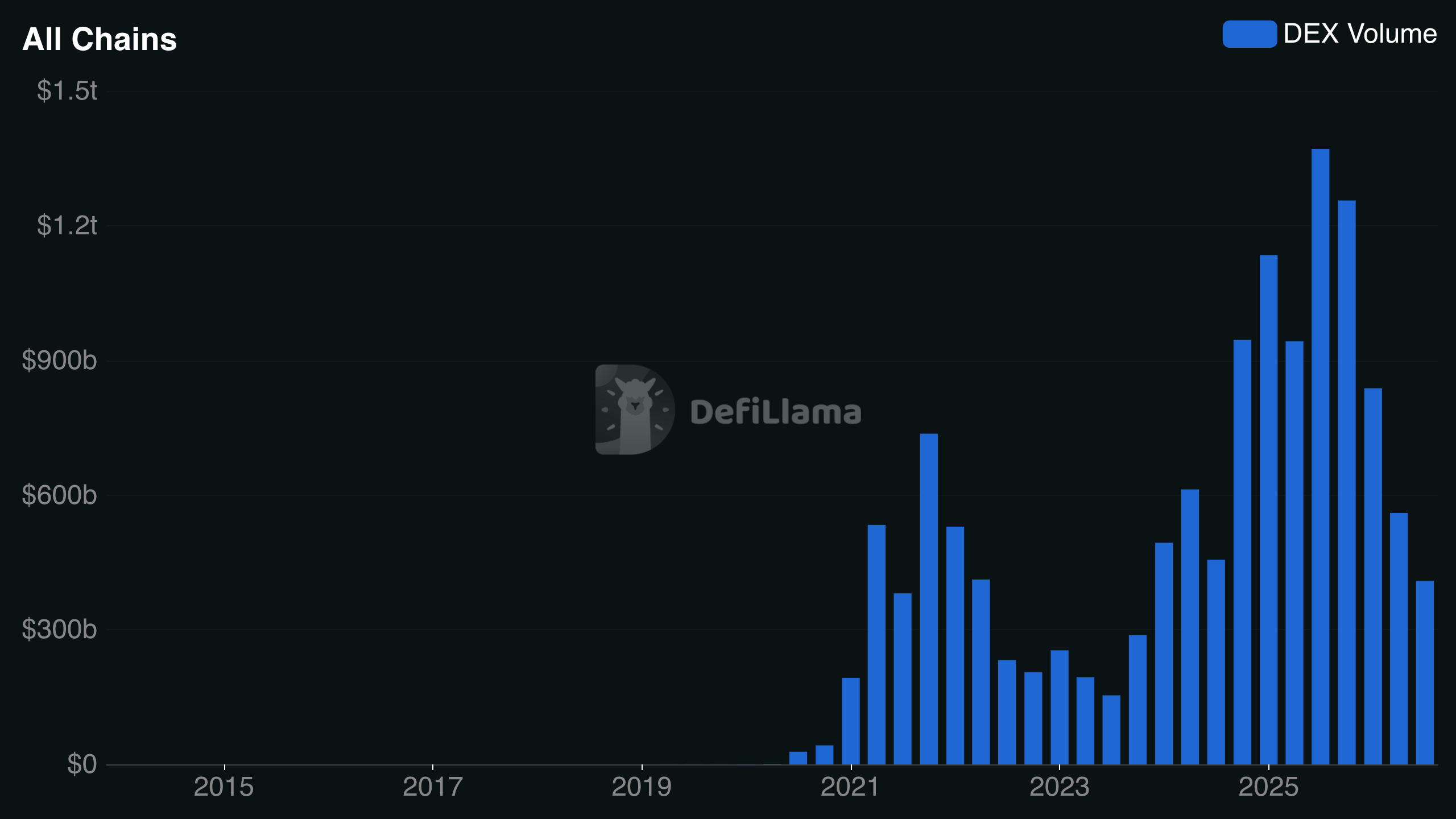
Figure 2: DEX monthly trading volume, 2014 to Sept 2026. Source: DefiLlama, retrieved Sept 2, 2026.
Lending and borrowing: Lending protocols host lending venues built on smart contracts where interest rates adjust automatically based on utilization. Users supply assets into pooled smart contracts to earn yield, while borrowers post overcollateralized positions to access liquidity instantly. Liquidators continuously monitor collateral ratios and can close undercollateralized positions to protect lenders.
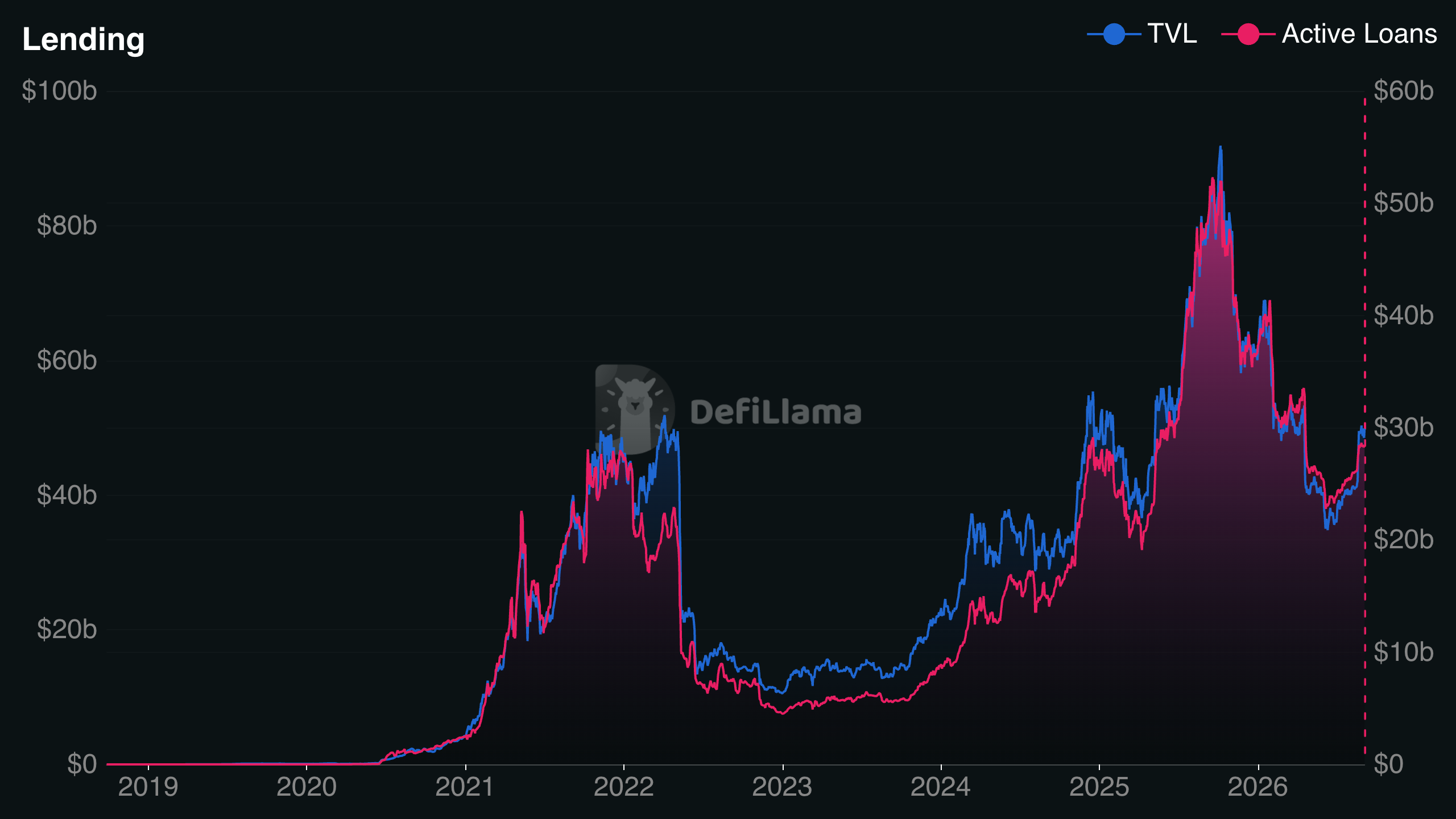
Figure 3: Lending protocol TVL and active loans, 2019 to Sept 2026. Source: DefiLlama, retrieved Sept 2, 2026.
Overcollateralization is the foundation of this design, but it is a layer of protection rather than a guarantee. The protection holds only when collateral can be liquidated near the price at which it is marked, and three considerations shape that in practice.
Collateral prices can move sharply enough that liquidators cannot act in time, leaving underwater positions to accrue as insolvent debt. The triggers are familiar, such as a de-peg event on a stablecoin or liquid-staking token, or an oracle mismatch where the on-chain price feed used by the protocol diverges from the realizable price on liquid venues.
The depth of secondary liquidity for the collateral asset, across centralized and decentralized venues, determines whether liquidators can clear positions profitably, since slippage in excess of the liquidation discount removes the incentive to liquidate.
Liquidations also concentrate, such that significant liquidations on one protocol can rapidly deplete the liquidity available for liquidations on another, propagating stress across the lending stack. Lending protocols address these dynamics at the parameter layer, through supply and borrow caps, loan-to-value ratios, liquidation thresholds, and oracle selection, all calibrated against simulated stress paths and adjusted continuously as market conditions evolve.
Curated lending vaults add an allocation layer above the protocol itself, sizing exposure to each market against the depth of its secondary liquidity rather than headline yield alone. Part 2 examines these frameworks in detail.
Vaults: As more users sought to drive yield by tapping into a matrix of onchain trading and lending opportunities, yield vaults emerged as a standardized infrastructure layer to optimize yield across primitives. Navigating this ecosystem while maintaining proper risk management, conducting ongoing due diligence, and tracking performance across fragmented allocations inherently creates significant operational overhead. Curators emerged to handle this operational complexity, optimizing yield and managing risk.
Vault strategies, monitoring capabilities, and onchain risk management have matured through battle-tested implementations across successive market cycles, and Part 2 covers how institutions can evaluate vaults based on these dimensions.
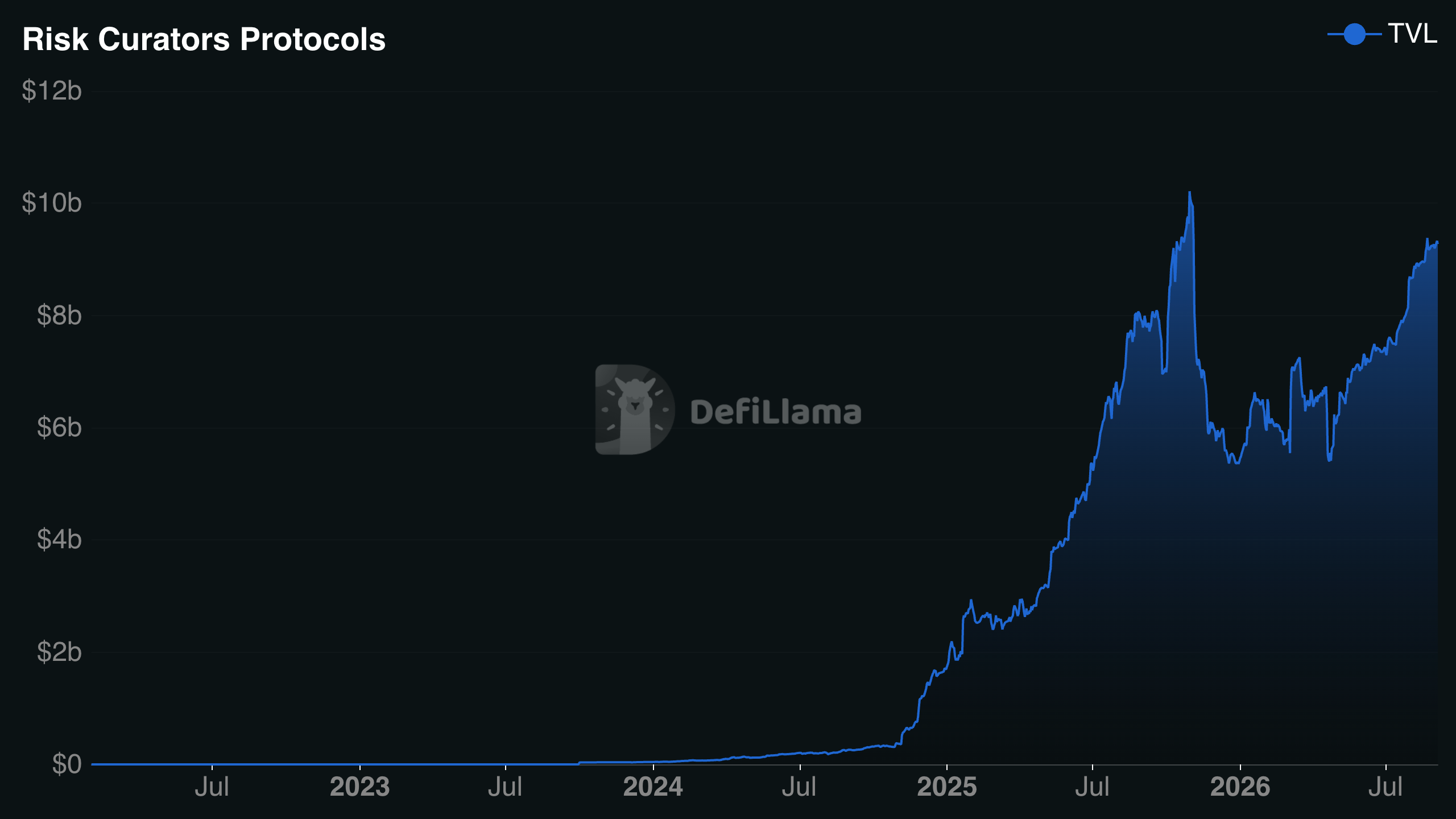
Figure 4: Risk curator vault TVL, 2022 to Sept 2026. Source: DefiLlama, retrieved Sept 2, 2026.
DeFi TVL overview
Takeaway: Following all-time highs at the end of 2021 and the start of 2022, the total value locked in DeFi is around $87.5b as of Sept 1, 2026.
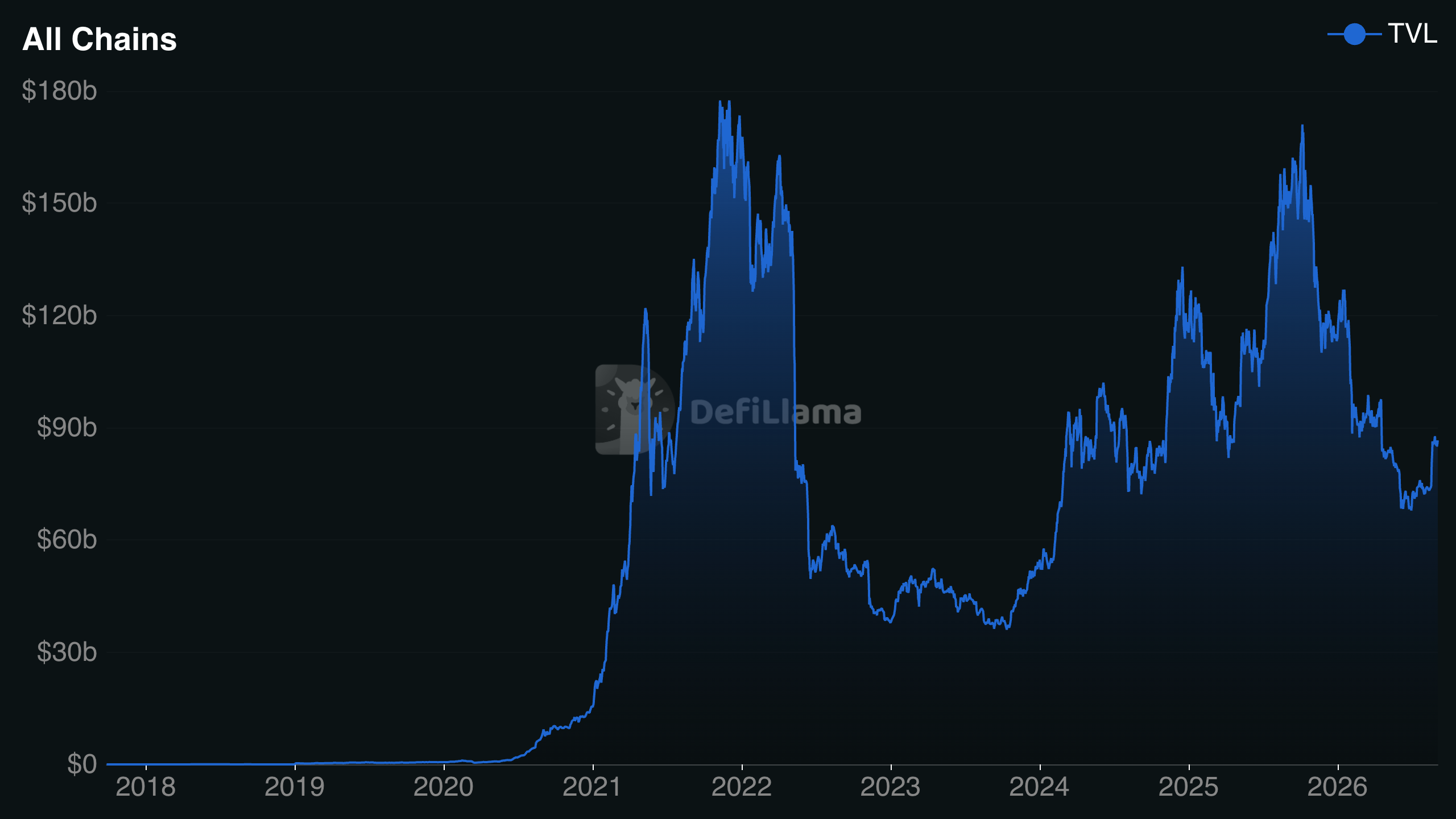
Figure 5: Total value locked in DeFi over time, 2018 to Sept 2026. Source: DefiLlama, retrieved Sept 2, 2026.
What is tokenization?
Takeaway: Tokenization brings traditional financial assets onto blockchain infrastructure, preserving their economic claims while enabling programmable settlement and continuous transferability.
Asset tokenization creates digital representations of real-world assets on blockchain infrastructure, such as fiat currency, treasury bonds, shares of stock, or funds. Tokens often represent ownership rights, legal claims, and economic interests in underlying assets, while also supporting programmable settlement and continuous transferability.
For example, BlackRock launched its USD Institutional Digital Liquidity Fund (BUIDL), a tokenized asset backed by cash, U.S. treasury bills, and repo agreements.
The tokenization landscape
Takeaway: Tokenization today spans every major asset class, with stablecoins leading by scale, tokenized treasuries and private credit growing the fastest, and equities, commodities, and real estate still in early innings.
Institutional capital is moving onchain across major asset classes:
- Fiat and cash equivalents: Stablecoins and tokenized deposits dominate this category. Total stablecoin supply sits at approximately $303b as of Sept 1, 2026, with use cases spanning payments, settlement, and yield-bearing collateral. Largest participants by supply: Tether (USDT, ~$183b) and Circle (USDC, ~$74b), which together account for roughly 84% of circulating stablecoin supply as of Sept 1, 2026.
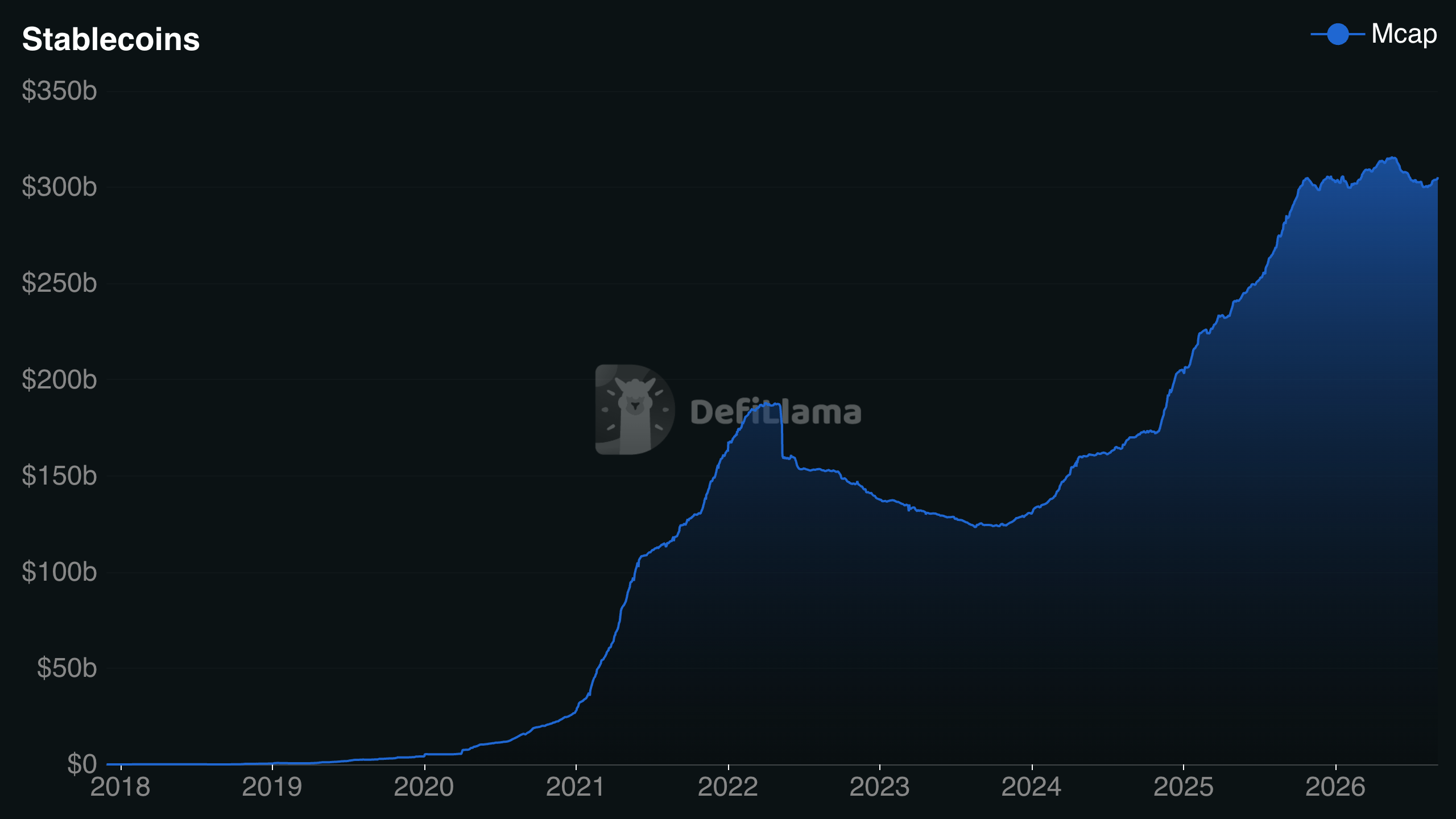
Figure 6: Total stablecoin market cap over time, 2018 to Sept 2026. Source: DefiLlama, retrieved Sept 2, 2026.
- Credit markets: Tokenized credit has reached approximately $45.1b as of Sept 1, 2026. Issuers benefit from real-time investor reporting and continuous transferability that traditional credit markets cannot offer at comparable cost. Largest participants by supply: Figure (HELOC-backed lending, the single largest issuer in the category), Tradable, Maple Finance, and Bridgetower.
- Investment funds: Tokenized money market and short-duration funds have reached approximately $15.9b onchain as of Sept 1, 2026. These products mirror the underlying exposure of traditional fund structures while settling on public blockchains and enabling intraday redemption. Largest participants by supply: Circle (USYC, ~$2.8b), Ondo (OUSG and USDY, ~$2.6b combined), BlackRock and Securitize (BUIDL, ~$2.8b), and Franklin Templeton (BENJI, ~$700m).
- Equities, commodities, and real estate: This category is earlier-stage but growing. Tokenized equities reached approximately $2.6b as of Sept 1, 2026, with Ondo Stocks and xStocks accounting for roughly 57% of supply between them. Tokenized gold sits at approximately $5b as of Sept 1, 2026 and is concentrated in Tether Gold (XAUT) and Paxos Gold (PAXG), which together represent roughly 90% of the segment. Tokenized real estate remains nascent due to legal and custody complexity.
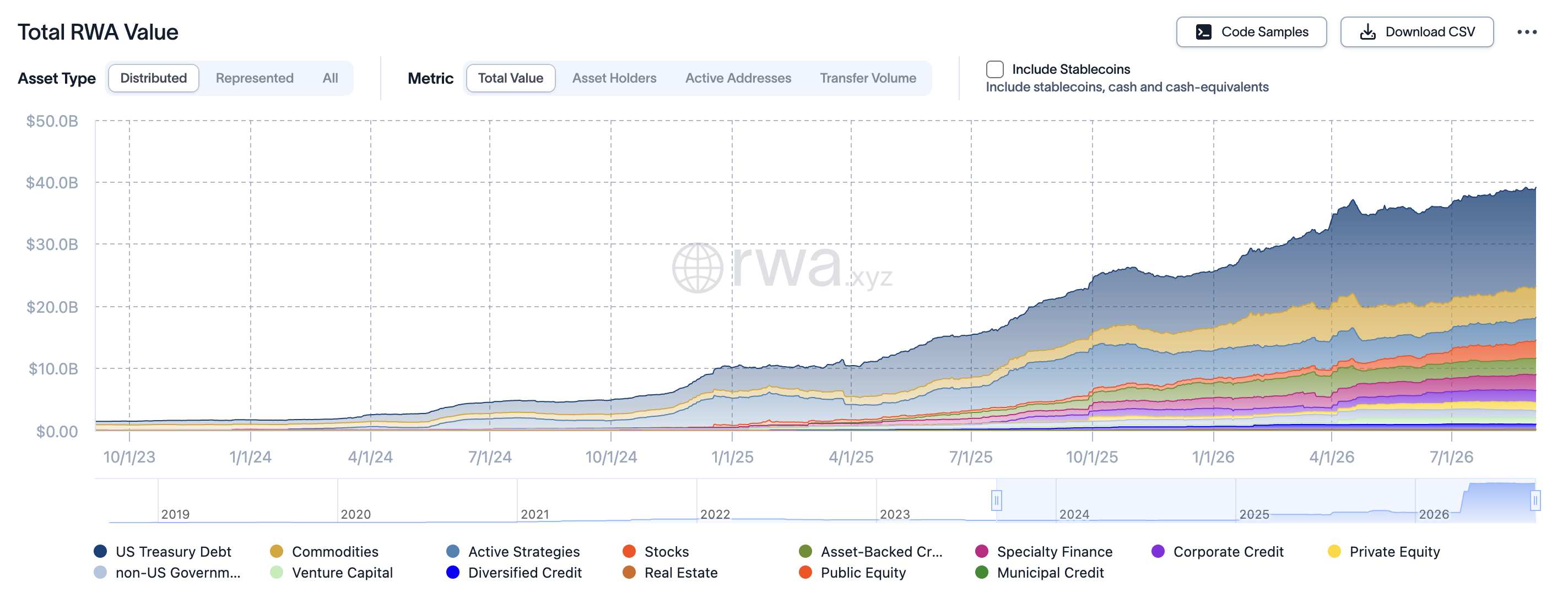
Figure 7: Tokenized real-world asset value by asset class, Oct 2023 to Sept 2026, excluding stablecoins. Source: rwa.xyz, retrieved Sept 2, 2026.
Why tokenize?
The case for tokenization rests on a set of structural improvements that compound when an asset moves from legacy systems to onchain rails. The benefits below address different pain points in how financial assets are issued, distributed, and serviced today, and together they explain why institutions across asset classes are running active tokenization programs rather than waiting for the technology to mature further.
Infrastructure advantages: Tokenization reimagines financial infrastructure by replacing legacy settlement systems with programmable assets that operate continuously. U.S. equities settle in T+1 with manual reconciliation and fragmented custody. Tokenized assets settle atomically in seconds on transparent onchain ledgers with single-source-of-truth ownership records visible to all.
Operational efficiency: Manual reconciliation, fragmented custody, and intermediary handoffs introduce latency and operational risk in traditional asset servicing. Tokenized assets carry their ownership and transfer history natively onchain, allowing audit trails, corporate actions, and reporting to be programmed at the asset layer rather than reconstructed across counterparties. The result is fewer reconciliation breaks, lower servicing costs, and the ability to automate workflows that currently require manual intervention.
Capital efficiency: Assets previously locked due to delayed settlement are immediately redeployable. Real-time NAV calculation enables dynamic portfolio management and intraday liquidity previously impossible in traditional fund structures.
Expanded market access: Public blockchains operate continuously, which means tokenized assets can be priced, traded, and transferred around the clock. For listed equities and ETFs that traditionally trade in single daily sessions, tokenization opens secondary-market activity across weekends, holidays, and global time zones. The same infrastructure widens access to gated products such as short-duration funds, private credit, and structured offerings. The benefit varies by asset class. It is easier where deep secondary liquidity already exists, and harder though not impossible for assets such as private credit that price on longer NAV cycles.
No single benefit explains the institutional pull toward tokenization. The combination is what matters: lower operational drag, broader distribution, programmable infrastructure, and more efficient capital use, applied to assets that already have institutional demand and clear use cases. Where these benefits stack on top of each other, tokenization moves from a forward-looking pilot to a measurable improvement on the status quo.
These benefits are conditional, and depend on the custody, oracle, and liquidity dynamics underneath the token. Part 2 addresses how institutions assess those dependencies.
Tokenization process
Bringing a real-world asset onchain involves two related but distinct layers. The first is the core infrastructure that every tokenized asset depends on, including the blockchain it lives on, the custodians and transfer agents that hold the underlying asset, and the oracles and attestation services that connect onchain ownership to off-chain reality. The second is the issuance sequence itself, the operational steps an issuer follows to launch and maintain a tokenized asset on those rails. Together, these layers determine the legal, operational, and technical guarantees an institutional investor can rely on.
Core infrastructure:
- Blockchain: The base layer where the token lives, settles, and transfers. Ethereum and Solana are the two common venues for institutional tokenization, with Stellar, Base, and Aptos hosting most of the remainder.
- Custodians and transfer agents: The off-chain perimeter. Qualified custodians hold the underlying assets and registered transfer agents maintain the official ownership record where required. Secure holding is table stakes.
- Oracles and attestations: The bridge between on and off-chain. Oracles relay reference data to the token contract, and independent attesters verify reserves and ownership on a recurring cadence.
Three infrastructure layers underpin every institutional tokenization, regardless of asset class. Issuers make explicit decisions at each layer based on their regulatory posture, the asset profile, and where they expect investor demand to come from.
The first decision is blockchain selection. Ethereum and Solana are the two leading venues for institutional tokenization today, each playing to a different strength. Ethereum carries the deepest concentration of institutional liquidity, wallet support, and cross-protocol integrations across asset classes. Solana has emerged as the primary venue for tokenized equities such as Ondo Stocks and xStocks, and for a fast-growing share of tokenized funds. Beyond those two, Stellar anchors most tokenized treasury supply through Franklin Templeton's BENJI, Base (a Coinbase-incubated Layer 2) has become a focal point for institutional issuance and stablecoin distribution, and Aptos was selected by BlackRock as the first non-EVM chain for its BUIDL fund. Multi-chain publishing is increasingly the norm. BlackRock's BUIDL alone is live on nine networks as of Sept 1, 2026 to meet investors where they already operate.
The second is custody. Qualified custodians and registered transfer agents handle the off-chain leg of every tokenized asset. They hold the underlying asset, manage investor whitelisting, maintain the official ownership record where required, and provide the operational and regulatory perimeter that institutional investors expect. Most tokenization stacks today rely on regulated third parties for these functions rather than building them in-house.
The third is the oracle and attestation layer. Smart contracts cannot directly observe the world off-chain, so oracles and attestation services bridge the two sides. Oracles relay reference data such as NAV calculations, asset prices, and corporate actions to the token contract, while independent attesters verify reserves and ownership records on a recurring cadence. Together, they give onchain holders the same information transparency that traditional asset servicing provides, with the advantage of being verifiable in real time.
The issuance sequence:
- Asset selection: Issuers identify the underlying asset and confirm it can be wrapped under applicable securities, custody, and AML/KYC rules. Public issuers typically face less approval friction than private ones.
- Custody model: Underlying assets are held by a qualified custodian or in-house under appropriate controls. Most institutional tokenization today relies on third-party qualified custodians for separation of duties.
- Minting and smart contracts: Smart contracts mint and burn tokens against the held asset, enforcing AML/KYC eligibility at the wallet level so only approved participants can hold or transfer the token.
- Verification and attestation: Depending on the structure, auditors or other assurance providers, transfer agents, custodians, and data or oracle providers may perform distinct verification, recordkeeping, or reporting functions at defined intervals. Issuers typically retain controls to update or reverse token state in the event of compromise.
With the infrastructure in place, the issuance sequence is what an issuer actually does to bring a specific asset onchain. Each step is intended to support legal and operational requirements, subject to the governing documents, asset structure, jurisdiction, service providers, controls, and applicable law, while introducing the programmability that distinguishes tokenized assets from their off-chain equivalents.
Issuance begins with asset selection. Issuers identify the underlying asset and confirm it can be wrapped under applicable securities, custody, and AML/KYC rules. Public issuers such as listed companies typically face less approval friction than private ones, where deal-by-deal legal review tends to drive the timeline. Once selected, the underlying asset is placed with a qualified custodian or held in-house under appropriate controls, and most institutional tokenization today relies on third-party qualified custodians for separation of duties.
With custody in place, smart contracts handle minting and burning of tokens against the held assets. These contracts enforce eligibility at the wallet level, restricting who can hold or transfer the token to participants that have cleared AML and KYC checks under the issuer's framework. The same contract logic can encode dividend payments, redemption windows, and transfer restrictions directly into the token's behavior, which is the source of most of the operational savings tokenization provides.
Verification runs on a defined cadence. Depending on the structure, auditors or other assurance providers, transfer agents, custodians, and data or oracle providers perform distinct verification, recordkeeping, or reporting functions, and issuers typically retain controls to update or reverse token state in the event of compromise. The end result is designed to provide selected controls and records comparable to aspects of traditional asset servicing, while retaining distinct technology, legal, custody, liquidity, and operational risks.
Conclusion
DeFi and tokenization sit at different points in the same shift. DeFi has matured into a working stack of trading, lending, and yield infrastructure with approximately $87.5b in value locked as of Sept 1, 2026 and continuous, programmable liquidity. Tokenization has progressed from concept to live deployment across cash, credit, funds, and a growing footprint in equities, commodities, and real estate. The two reinforce each other. Selected tokenized assets are beginning to interact with onchain markets, creating potential opportunities for trading, financing, collateral use, and other programmable functions. In turn, DeFi protocols may gain access to assets and participation structures that are more familiar to institutional market participants. The extent of this convergence will depend on legal eligibility, custody, identity, governance, liquidity, interoperability, operational resilience, and regulatory requirements.
This first installment has covered the foundations. Part 2 turns to the institutional opportunity itself, examining where the most active use cases sit today, how institutions are accessing onchain markets in practice, and the risk frameworks that may help institutions identify, assess, monitor, and manage relevant risks.
Part 2 examines how institutional risk-management practices may apply to DeFi, the role of identity and access controls in different participation models, and how institutions can assess liquidity, market, technology, custody, governance, counterparty, and operational risks. It also considers the use of vault structures, monitoring capabilities, and other risk-management tools observed in live implementations.
Report
View the full presentation
Read the full paper